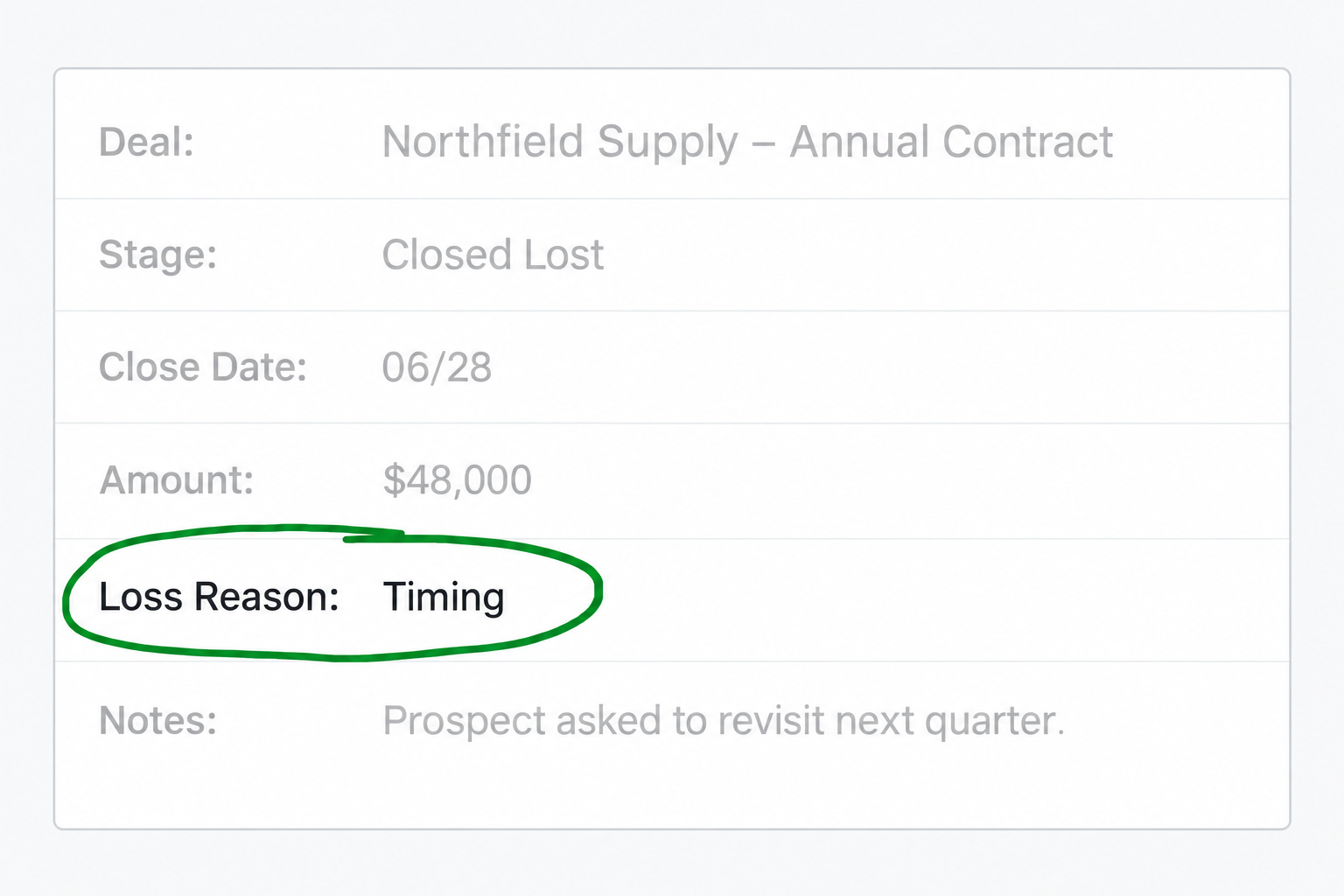

Open your CRM, filter to closed-lost from last quarter, and find the one you can still picture. It got past the first screening call. Two people from their side came to the demo and asked good questions. Then replies got slower, the next call got pushed twice, and a rep eventually closed the record and picked a reason from the list. The reason says timing.
Some of those deals really did lose to timing. Others didn’t, and you can tell which is which from records you already have. The ones that didn’t, stalled because the buyer couldn’t picture what working with you would actually be like, and no report you own has a field for that.
Start with the record itself. It has a close date, a stage, an amount, a reason code, and maybe two lines of notes. What it doesn’t have is anything about what the buyer was unsure of in week six, or what they went looking for on your site and didn’t find. The record tells you the deal stopped. It cannot tell you what stopped it.
Most of the monthly report measures attention
Look at the numbers you actually report. Sessions, new contacts, content downloads, leads sales agreed to call, how many live deals your campaigns had a hand in, what each channel costs you per lead. Take one and walk it down to what it literally records.
A content download means a person traded an email address for a PDF. That’s the whole event. It tells you someone filled in four fields on a Tuesday afternoon. It tells you nothing about whether they could picture your product living alongside the tools their team refuses to give up, or whether they forwarded it to the colleague who holds the veto.
Almost everything on that list works the same way, and attention is the one thing you already have by the time a deal reaches a sales conversation. Two look like exceptions: the pipeline number, and anything with revenue in its name. Both are just sums of deals. The reason each one landed where it did was recorded by someone else, in a dropdown with four options.
Reason codes look like the other exception, because they’re the one place the system asks for a why. Then look at what your own field offers. Every company configures that list differently, and it usually runs something like timing, budget, no decision, went with another vendor. All of those describe the buyer’s calendar or the buyer’s approval chain.
There’s rarely an option for “couldn’t see enough to decide,” so the rep picks the nearest available label and moves on to the deals that are still live. Nobody’s being careless; the field just has nowhere to put it.
And if your reason field is free text, or mostly blank, or mostly “Other,” that is a finding on its own: the question was never really asked.
Three places the signal is already recorded
The signal is recorded, though, in material you already own and probably don’t read as a set.
- Closed-lost notes on late-stage deals, meaning the ones that got past a demo or a proposal, whatever your pipeline calls that. Not the codes, the free text underneath them.
- The questions whoever runs your sales calls answers every single time. If the same three come up in twenty calls, a buyer can’t find those answers on their own, and what a rep gives them is the company’s own account of itself.
- Your own analytics on the pricing page and the customer stories page. Long time on page, no next click. Someone stayed, read carefully, and left without doing anything.
Start with the first one. It costs an afternoon and no budget.
Pull the last two quarters of closed-lost and filter to deals that reached late stage, so you’re reading about buyers who were serious. Ignore the reason column for now and read the notes, in order, all of them. Most of them will be one line long.
Where the notes are thin, the last few emails on the thread or the recording of the final call will usually tell you the same thing. You’re not looking for a smoking gun, you’re sorting the pile.
Read for four things:
- A request for another reference after references were already provided.
- A new stakeholder added in week five who hadn’t been in any prior meeting.
- Questions about onboarding, or about who the buyer would actually be working with after signing.
- “Let’s revisit next quarter,” with nothing in next quarter that would change the decision.
One of those alone means nothing. Deals do genuinely lose to timing, and when they do, the note usually names the thing: the hiring freeze that landed in October.
What you’re looking for is the other pile, the one where the note reads like someone who ran out of information and defaulted to waiting. An hour is usually enough to see whether that pile is a few records or most of them.
Then put a number on it. If that pile is a third of your late-stage losses, a third of last quarter’s lost pipeline sits inside it, and the same share is moving through your open deals right now. Ask what it would have taken to show those buyers the thing they couldn’t see.
What the buyer was doing while the numbers held up
Through all of it, the buyer was building a picture of life after they sign, out of whatever they could see from outside.
Take the first month after they start. Skip the kickoff and look at the ordinary weeks after it, when the buyer’s own team has to live with the decision every day.
That is what the late questions are circling: who on their side fields the questions in the hallway, how long before people stop talking about the switch, and whether the colleague who complained for a year about the last change will actually use this one. They get aimed at your references rather than at you.
You’ve watched customer after customer go through it. Almost none of it is on your site, where the onboarding page describes your process in your words.
When a buyer can’t find it, they don’t pause and ask. They fill it in from experience, usually from the last time a change like this went badly on them, and then they carry that version into the internal conversations you never get to attend.
Why more content doesn’t move it
The next thing on your roadmap is probably a comparison page against the two vendors you keep losing to. When it ships it will do what content does: sessions rise, the monthly number holds.
It won’t touch the picture the buyer was assembling, because it’s your company describing itself again. The dashboard gets healthier and the deals stay where they are. That distance is easy to read as an attribution problem, and attribution is usually what gets fixed.
The part you cannot supply yourself
Whatever is missing has to come from somewhere other than your marketing team. Your buyer has already read what your site claims and discounted it appropriately, the same way you discount your competitors’ sites. What they haven’t heard is a person in their role, at a company like theirs, describing what the work was actually like.
That’s what customer proof is for, and it only carries weight when the story covers the part a case study would have cut: the week things stalled, and what your team actually did to recover. That stretch is the messy middle, and it is one of the five things worth auditing in your own library.
Go read the customer stories on your own site with that question in mind. The ones that mention a week when it was hard are the ones doing the work.

Score it now, sharpen it later
You probably suspect there’s a gap. You almost certainly can’t say where it sits or how big it is. That’s the part worth fixing today.
The Customer Proof Audit Scorecard is 25 questions, scored out of 125, across five dimensions of your customer proof: Customer Experience Visibility, The Messy Middle, Proof Depth & Authenticity, Deployment Coverage, and Freshness & Relevance. It’s designed to turn a suspicion into a number you can put next to the ones you already report.
Score it now on what you already know, then score it again once you’ve read those closed-lost notes. It’s free inside the Testimonial Revenue Toolkit.
