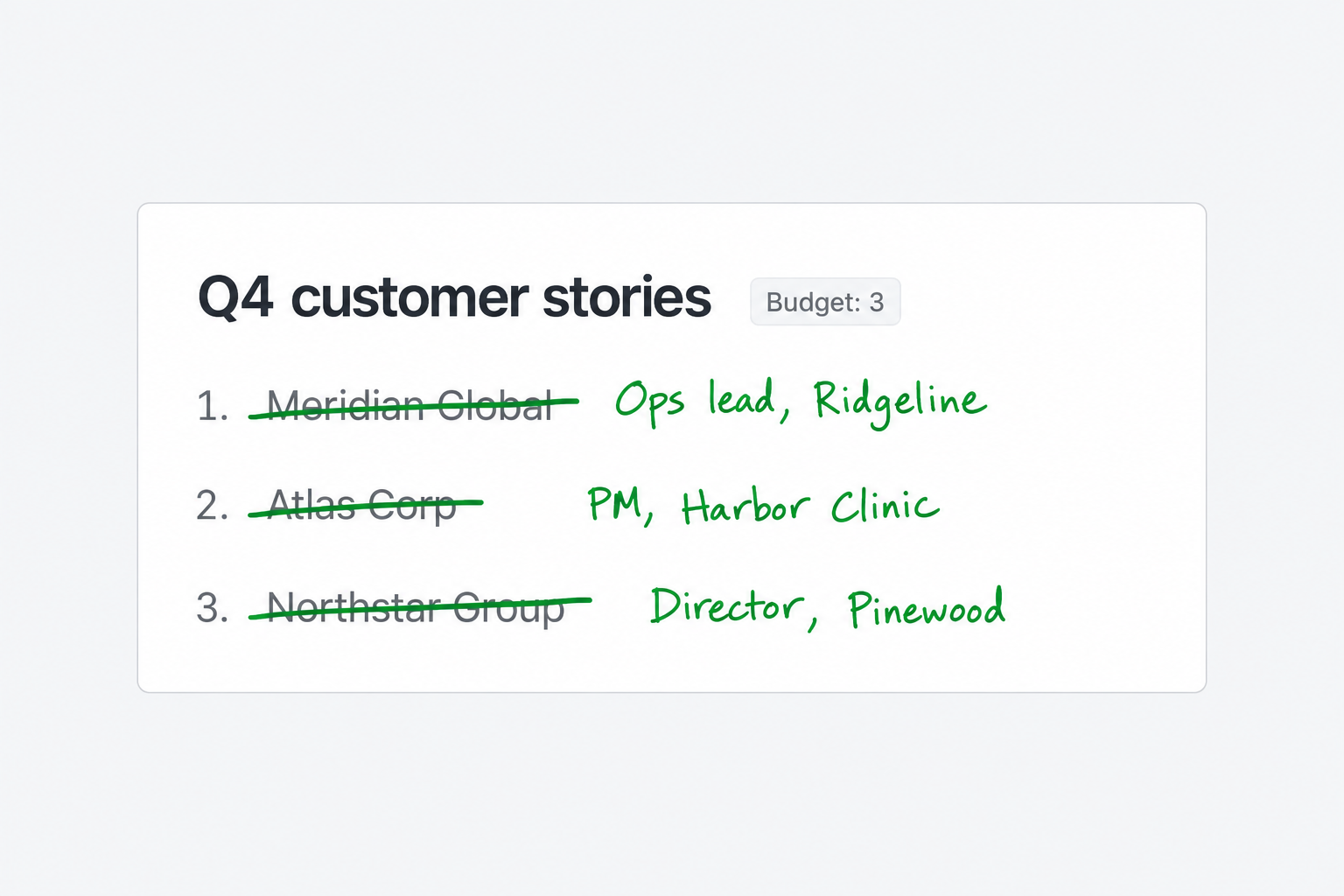

You have budget for three customer stories this quarter. Which three should you film first?
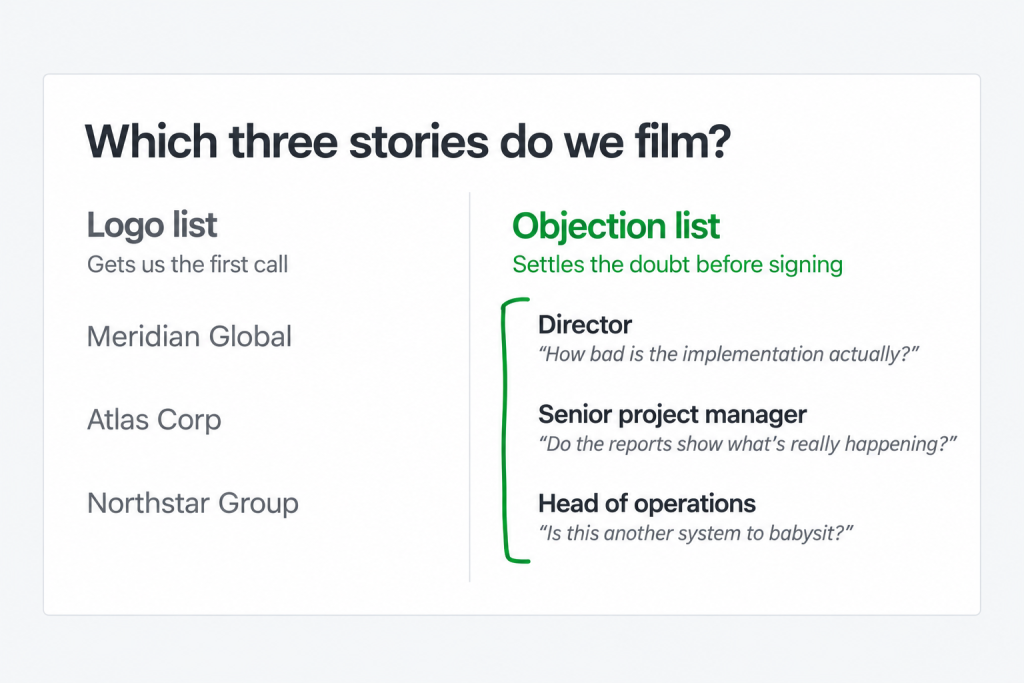
The plan on the table is the three biggest names on your customer list. Your CMO likes it, and for a fair reason: a recognizable name earns a first call.
There’s a better way to spend the three. Pick each story for the objection it answers, meaning the specific doubt that makes a buyer hesitate in the last weeks before signing.
Late in a deal, those doubts are practical. They’re about what living with the product will be like day to day, and the person who can settle them is whoever lives with it day to day at a customer like the buyer’s.
That’s not the executive who signed at a marquee account. It’s the operations lead at a smaller one, who moved her own team onto the product and remembers what went wrong. She can move a stalled deal when a famous logo can’t.
This post shows where to find the doubts stalling your deals, how to match each one to a customer who can answer it on camera, and how to defend the list when someone asks where the big names went. You’ll leave with three named customers, each tied to a reason deals slow down.
Why does a famous logo stop working late in a deal?
A big logo earns its place early, on the homepage and in the first sales deck. By the late stage of a deal, the buyer has seen it already. That stage starts after the demo, when the people who will use your product every day join the calls. What slows the deal now is a doubt specific to her team, and in the sales notes it often sounds like this:
“Our ops lead is worried this becomes another system she has to babysit every day.”
No logo answers a doubt like that one. Another ops lead can, by describing what a normal week looks like now, including the part where she still has to step in. A story that skips past her doubt gets a polite nod, and the deal goes quiet anyway.
There’s a practical reason to look past the logo, too. At a large customer, the person closest to the problem is often several approvals away from anyone who can say “yes” to a video.
Each approver trims something. The week that went badly comes out, then the feature that didn’t work at first, then the name of the person who fixed it. What reaches the camera is a polite endorsement with nothing in it a buyer could recognize from her own situation.
At a smaller customer, the ops lead usually ran the move to your product herself and can often agree to the interview on her own.
Where do the real objections come from?
Start with the objections themselves, and don’t write the list from memory. Marketing tends to hear the objections the website answers. The ones stalling deals show up in two places:
- The rep who runs your late-stage calls. Ask which three objections they answer on every call after the demo. They’ve answered each one dozens of times and can list them without thinking.
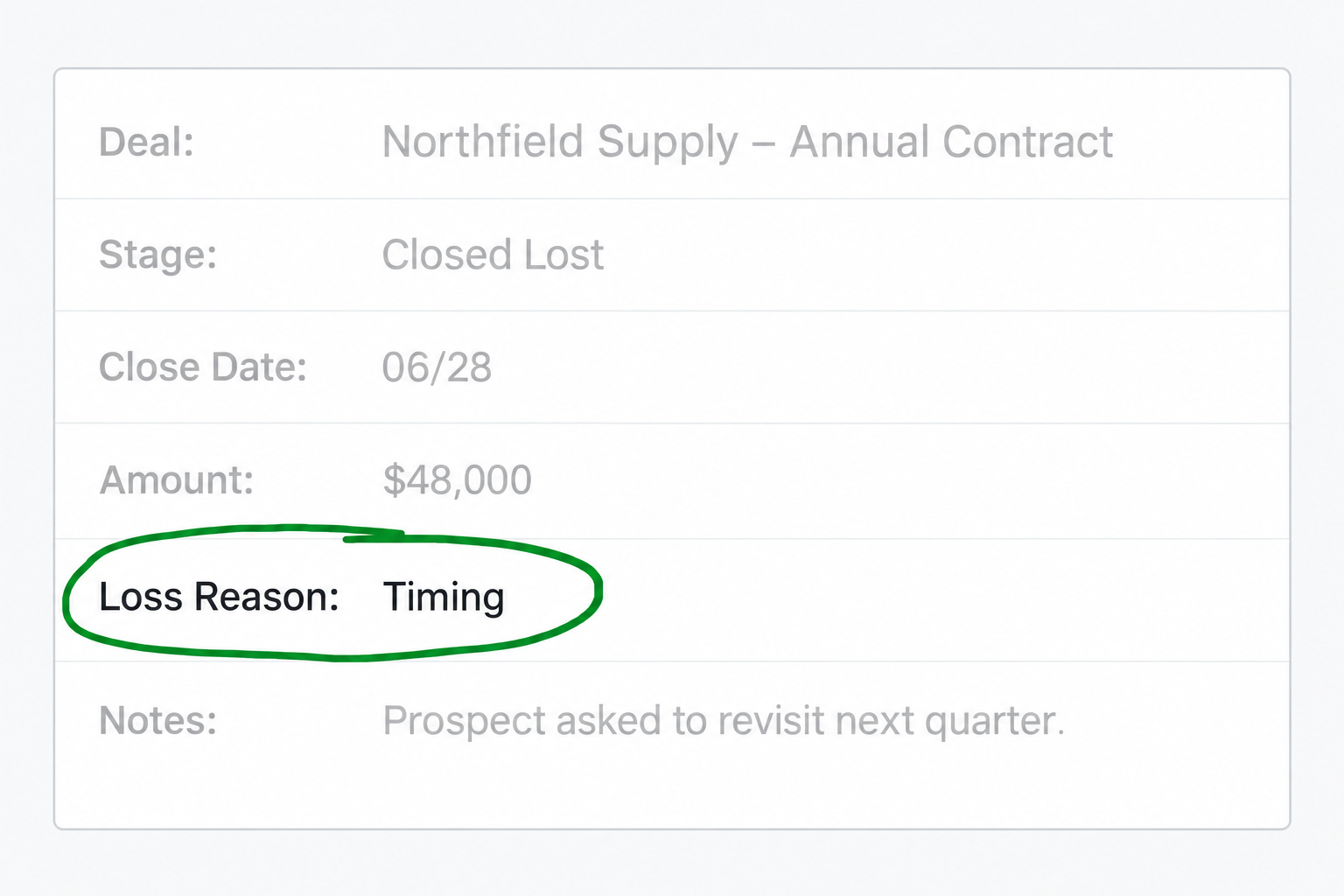
- Last quarter’s closed-lost notes, the few lines a rep writes when a deal is closed as lost. Some deals marked “timing” or “no decision” stalled because the buyer couldn’t see enough to feel safe signing. Here’s how to read closed-lost notes for the deals that stalled on missing proof.
Usually the rep’s list and the notes point at the same three things. When they don’t, trust a note that gives a reason. If the note just says “timing,” ask the rep who was on the call.
Why does a buyer need to see the answer instead of hearing it?
Once you have your three objections, the next question is what would settle each one. Sales has an answer for every one of them, and that’s the problem.
“Implementation is easy” is a line your team gives every week, and the buyer discounts it the way she discounts every vendor’s claims. What she can’t discount is a customer’s ops lead walking through the first month, week by week, including the week things went wrong and what it took to fix them, because the buyer can watch it and judge it for herself.
For each objection, write down what a buyer would need to see to set the doubt aside, concrete enough to film. “Reports they trust” is too loose to point a camera at. “A project manager who runs her weekly standups off the dashboards and says the numbers match what her team did” is a scene.
How do you pick which customer tells each story?
Beside each objection, put a name: the one current or past customer who could show that scene. Pick a person, not a segment. “A mid-market customer” is a category, and a named ops lead is someone you can actually ask.
You’re choosing a person for what she can show, and her company comes with her. Sometimes it’s one your CMO has never heard of. The buyer is watching a peer describe her week, and the logo in the corner is not what settles her.
If an objection ends up with no name beside it, you’ve learned something before booking anything: nobody has that story yet.
The Evidence Gap Worksheet in the free Testimonial Revenue Toolkit walks through these questions, with a filled-in example ahead of the blank one.
What does a finished list of customer stories look like?
Three entries, each with the same three parts: the objection in the buyer’s words, what she would need to see, and the customer who can show it. Here it is filled in with the toolkit’s example, a mid-market project-management software company with a marketing team of four and an average deal of $28,000 a year.
- “How bad is the implementation actually?” The first month, week by week, including the rough weeks. Told by the director who moved her team over last quarter.
- “Do the reports show what’s really happening, or just whatever people remembered to type in?” A peer confirming the numbers match what her team did. Told by a senior project manager who runs her standups off the dashboards.
- “Our ops lead is worried this becomes another system she has to babysit every day.” A normal week now, including where she still has to step in. Told by the head of operations at a company the buyer’s size.
None of the three was picked for its logo. Each shows the buyer her doubt answered by someone in her job.
Where do the big names fit?
Bring this list to your next planning conversation, and expect the question:
“Where did the big names go?”
They still have a job. A recognizable name earns the first call, and the logo wall and the quotes on the homepage keep doing that work this quarter. The first check on the new list is whether one of your big-logo customers has a person who can answer one of the three objections. If so, she goes on the list and the logo comes with her.
The three stories are for the other end of the deal. By then the buyer has had the demo and weeks of calls, and she’s about to push the decision to next quarter over a doubt one of your customers could settle for her.
Every month a deal like that sits, the rep’s time in it is spent and the buyer’s attention drifts to whatever else is on her desk, and some of those deals never come back. What those late-stalling deals are worth in your own numbers is the figure to bring.
Then say how you’ll know it worked. Keep a list of every late-stage buyer a rep sends one of the three stories to, and what each one did next, whether she booked the next call, signed, or went quiet anyway. A few months in, that list shows whether the three stories are doing the job the logos never could, and which of the three deserves a sequel.
Once the list holds up, the work shifts to getting three “yes” replies, which comes down to an ask that reads as recognition rather than a favor. The Evidence Gap Worksheet in the free Testimonial Revenue Toolkit lays out the whole path from objections to named stories, with a worked example and a blank version to fill in.